Czech food is heavy. Now, don’t get me wrong, I’m a meat and potatoes kind of gal, but I think I’ll steer clear of the goulash and gravy for a long while.
 Fruit in the market
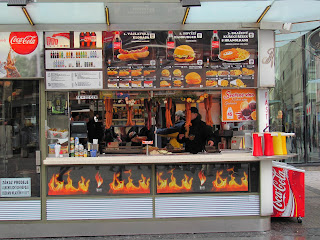 All too common sight of kielbasa and spiced wine stands
 Mmm, sugar rollsCzech food is heavy. Now, don’t get me wrong, I’m a meat and potatoes kind of gal, but I think I’ll steer clear of the goulash and gravy for a long while.Fruit in the marketAll too common sight of kielbasa and spiced wine stands Mmm, sugar rolls


 We went to see what wasn’t there: a town obliterated by the Nazis. Lidice was found to be connected to the assassination of Heydrich, so it was ordered to be destroyed as a symbol of Nazi power. The men were lined up and shot, the women sent to concentration camps, and the children assessed for racial purity to be “reeducated” or sent to a concentration camp. What was once a small farming and mining community is now negative space in memorial to the victims.
 Steps to what was the church
  House of the Black Madona, which houses the Grand Cafe Orient, with one of the few Cubist interiors
 Hmm, Cubist fruit? I think deliscious!
 Even a Cubist lamppost
 Mucha’s depiction of the seasons
 The Grand Hotel Europa, where we had a fine dinner of eggplant and cheese; duck, beets, and bread; and apple strudel.
 Stained glass on The Municiple house, designed by Mucha. The restaurant inside is called Francouzska and served us mango crème brulee for dessert.
 Couple of fine Art Nouveau gals

As rights were slowly taken away, maybe more in self censorship and fear than de jure, the resistance movement grew. In 1969, student Jan Palach set himself on fire in Wenceslas Square to protest compliance with extinguished rights. Resistance continued with Charter 77, an unofficial civic movement of intellectuals and artists who petitioned their government to implement the human rights they had agreed to by signing the UN Declaration of Human Rights. Our class met one signer, Jaroslav Hutka, a folk singer who was sent into exile for singing about freedom to rally resistors.
Communism fell in Czechoslovakia in 1989 with the Velvet Revolution. It was a peaceful overthrow in response to violent police intervention of a student protest. Havel, the same Havel Jaroslav sings of, was elected president of the new Czech Republic.