30 March 2012

Nyhavn!

Classes have let out for spring break today, and this is where I spent my afternoon:
Nyhavn! It actually exists, and it actually is this beautiful! The small harbor is lined with cafes, ships, and loads of Danes enjoying the sun and spirits.

It is one of the quintessential Copenhagen sites for a reason.

And then there is den lille havfru! In reference to Hans Christian Anderson’s story, she sits waiting…

21 March 2012

St. Patrick's Day

While it’s not hugely popular in Denmark, Copenhagen celebrated St. Patrick’s day with some Irish dancers, bagpipes, and a participatory parade. Then again, some people get really into it…


I celebrated by going to the Louisiana Museum of Modern Art. The Museum is built around a little park right next to the ocean with the revived humanistic idea of nature as art. It is not intended as a teaching museum, so there aren’t a lot of words or explanations behind the pieces. In this way it is “perceptually democratic.” Young, old, Danish, American, educated, non-educated: what we all have in common is the ability to feel and experience, which is really what art is all about.


See it sort of looks like a Louisiana plantation house, but the story goes that the man who first owned the property had three wives- all named Louise!

Street Sight: Anders Flanderz

Copenhagen is coming out of hibernation! This means an abundance of street performers including this one man band, Anders Flanderz, highly reminiscent of Bert from Mary Poppins…

Very entertaining! Or at least more so than the accordion player who only knows The Winner Takes it All by ABBA and Time to Say Goodbye by Andrea Bocelli.

P.S. I've just figured out this new-fangled youtube thing. More videos to come!

10 March 2012

Czech: Food

Czech food is heavy. Now, don’t get me wrong, I’m a meat and potatoes kind of gal, but I think I’ll steer clear of the goulash and gravy for a long while.


Fruit in the market

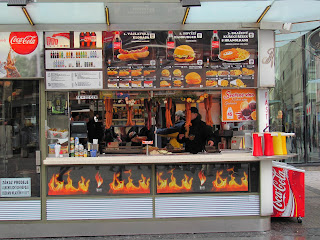
All too common sight of kielbasa and spiced wine stands


Mmm, sugar rolls

Czech: Cesky Krumlov

Czechoslovakia became a nation in 1918. The new borders, drawn by the post WWI Treaty of Versailles, include the Sudetenland, a predominantly German area. When Hitler came to power in Germany in 1933, his goal is to unite all German speakers into one country, so his first target is the Sudetenland, which included Cesky Krumlov. To avoid another war, France and Britain sign the Munich Agreement officially giving the Sudetenland to German. Czech representation was not invited. The Czechs of the Sudetenland were transferred elsewhere and Germans moved into their homes. After the war, the roles were reversed as Germans were transferred from the Sudetenland, often using the same tactics as the Nazis had with armbands and cattle cars. Nationality, a concept created in the 19th century, ceased to be a choice by the 20th century.

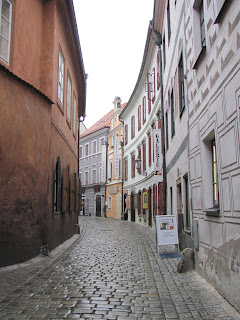
Today, Cesky Krumlov is a town untouched by time, hidden in the bend of a river. Tourists are attracted because of the castle (not to mention the Vampire Princess, Eleonora who is doubly sealed into her grave under the church). Without knowing the history of the transfers, you would never know that some 70 years ago, Hitler marched through these very streets.

Czech: Lidice

We went to see what wasn’t there: a town obliterated by the Nazis. Lidice was found to be connected to the assassination of Heydrich, so it was ordered to be destroyed as a symbol of Nazi power. The men were lined up and shot, the women sent to concentration camps, and the children assessed for racial purity to be “reeducated” or sent to a concentration camp. What was once a small farming and mining community is now negative space in memorial to the victims.

Children's memorial


Steps to what was the church

Czech: David Cerny

Our class had the opportunity to meet a contemporary sculptor, David Cerny, whose works are displayed throughout Prague. If I had to describe him in four words, I would say vulgar, scattered, controversial, and absolutely brilliant. But his art speaks for itself:
Cerny's portrayal of King Wenceslas


A rotating skull that got rejected from the mall for which he designed it. It now resides atop a modern art museum.

Cerny has a collection of these identical babies, 10 of which climb the TV tower:


Finally, the men who pee philosophic quotes into a Czech shaped fountain.

I could tell you how these sculptures have been related to anti-communism and nationalism, but the truth is, Cerny never tells the true intention of his boundary pushing works, so I guess I'll leave it open for interpretation... But I will warn you, whatever you say it is, there is a good chance Cerny will say it is the opposite.